 ENG
ENG
 INA
INA
Public Discussion on Policy Direction and Challenges in Bali's Development
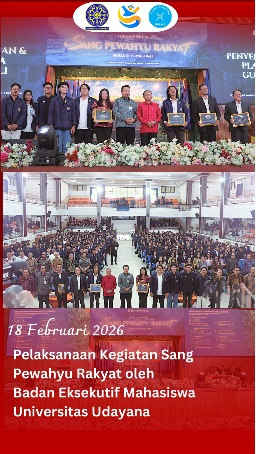
BADUNG – Bali Governor Wayan Koster outlined a number of programs currently being undertaken by the Bali Provincial Government, such as reducing stunting rates, unemployment rates, and school dropout rates. He conveyed this while speaking at the Public Discussion “Sang Pewahyu Rakyat” (The People's Messenger) held by the Udayana University Student Executive Board in 2026, at the Widya Sabha Auditorium, Jimbaran, Badung, on Wednesday (18/2).
The Governor of Bali also outlined several issues, such as the scarcity of third (Nyoman) and fourth (Ketut) children, which will affect the preservation of culture. Development in Bali was also highlighted, because in addition to having a positive impact, it also causes problems for Bali's nature, people, and culture. Considering that the conversion of rice fields continues to increase, there is more and more waste, damage to the environmental ecosystem, threats to the availability of clean water, and increasing traffic congestion, as well as economic disparities between the Sarbagita and non-Sarbagita regions.
The Governor of Bali also said that the public infrastructure and transportation are far from adequate, business opportunities for the local Balinese community are decreasing, the practice of purchasing assets using the names of local Balinese people is increasing, cases of drugs, prostitution, and security are on the rise, exclusive foreign communities are emerging, desecration of sacred sites is increasing, and Balinese cultural norms and authenticity are being destroyed.
To prevent the population deficit that is predicted to occur in 2050, his office continues to socialize and enact regulations to maintain population growth by maintaining a resilient population that will be tasked with preserving and sustaining the culture. This is done by discontinuing the 2-child Family Planning (KB) program and replacing it with a 4-child or more KB program in Bali by providing incentives for the birth of a third -3 (Nyoman) and the fourth (Ketut) starting this year. These incentives are provided by assisting with their education up to a bachelor's degree through the “One Family, One Bachelor's Degree” program, thereby creating a superior human resource (HR) pool in Bali.
To realize Bali's development framework, it is implemented in a planned manner, taking into account the characteristics of the Province of Bali with a thematic, comprehensive, and integrated approach between nature, humanity, and culture, in accordance with Law Number 15 of 2023 concerning the Province of Bali and the development of the Province of Bali.
Bali Governor Wayan Koster also conveyed a number of policy directives and programs for the 2025-2030 period through the Bali Future Development Policy, 100 Years of Bali New Era 2025-2125, which is a manifestation of the sincere intention to glorify Nature, Humanity, and Balinese Culture as a noble gift.
The Rector of Udayana University, Prof. I Ketut Sudarsana, expressed his pride and appreciation for the idea of the Student Executive Board to hold a public discussion entitled “Sang Pewahyu Rakyat” (The People's Prophet), which touched on current issues in Bali, such as how to maintain a balance between economic growth and noble values amid modernity and local wisdom, as well as investment and cultural integration.
The event was also attended by panelists, one of whom was Prof. Dr. Putu Gede Arya Sumertayasa, SH., MH, Dean of the Faculty of Law at Unud, who highlighted the issuance of business licenses directly from the Central Government and its negative impact on tourism in Bali.
The event, organized by the UNUD Student Executive Board (BEM UNUD), aimed to examine public policy, strengthen transparency, and accommodate community aspirations through academic studies. (*)
UDAYANA UNIVERSITY