 ENG
 INA
Examined Directly by Prof. Mahfud MD, I Made Suardana Officially Earns Doctorate in Law from Udayana University with the 'Ethical Audit Pre-Justicia' Concept
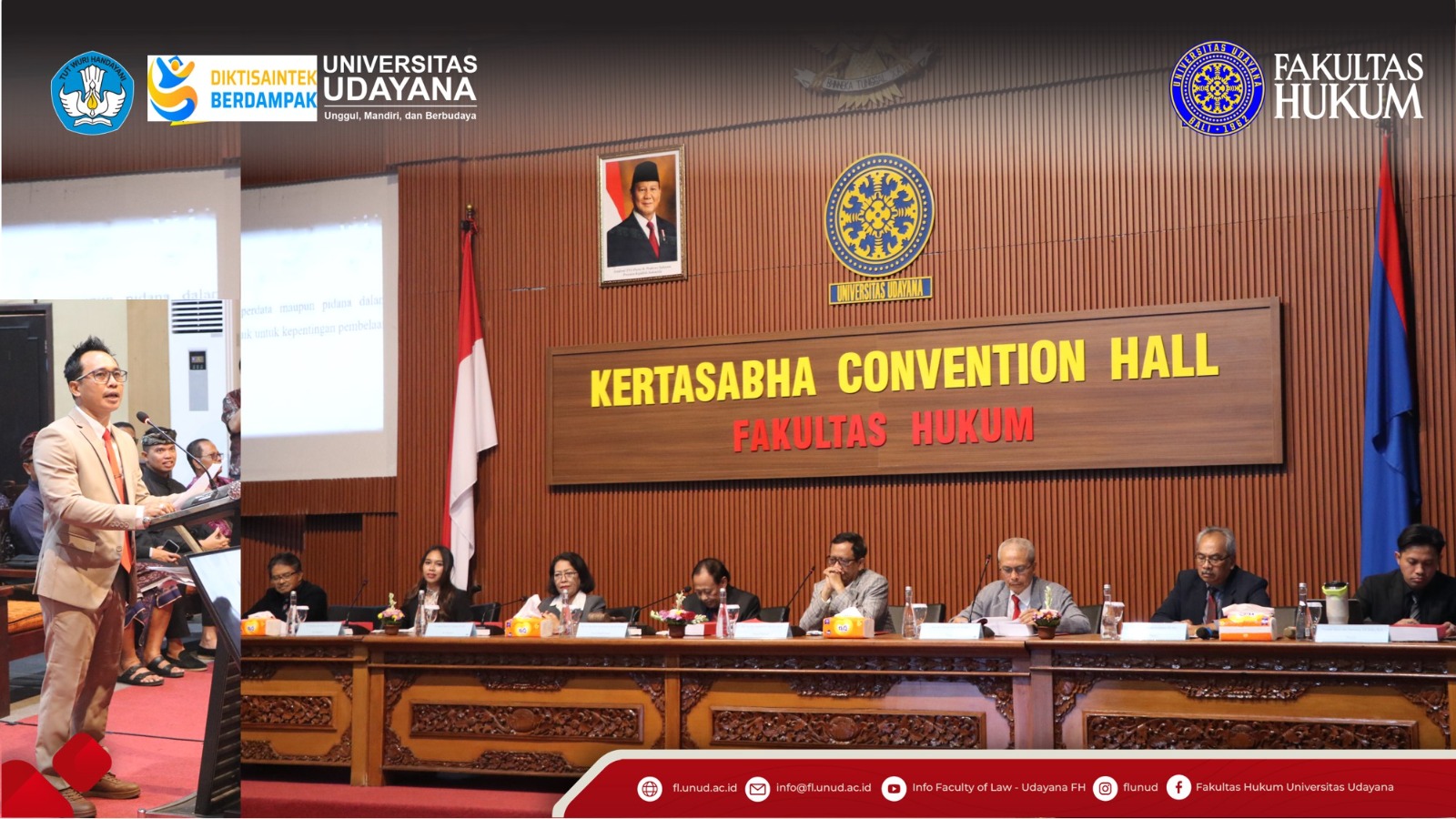
DENPASAR – The Doctoral Program in Legal Studies (PSDIH), Faculty of Law, Udayana University (FH UNUD), has once again produced a new doctor through an Open Doctoral Promotion Defense held at Kertasabha Convention Hall, FH UNUD, on Thursday (November 26, 2026). During the public defense, which took place from 10:00 AM to 1:00 PM WITA, doctoral candidate I Made Suardana successfully defended his dissertation titled 'Construction of Procedural Regulations for Handling Obstruction of Justice Against Advocates in Providing Legal Assistance in Corruption Crime Cases in Indonesia.'
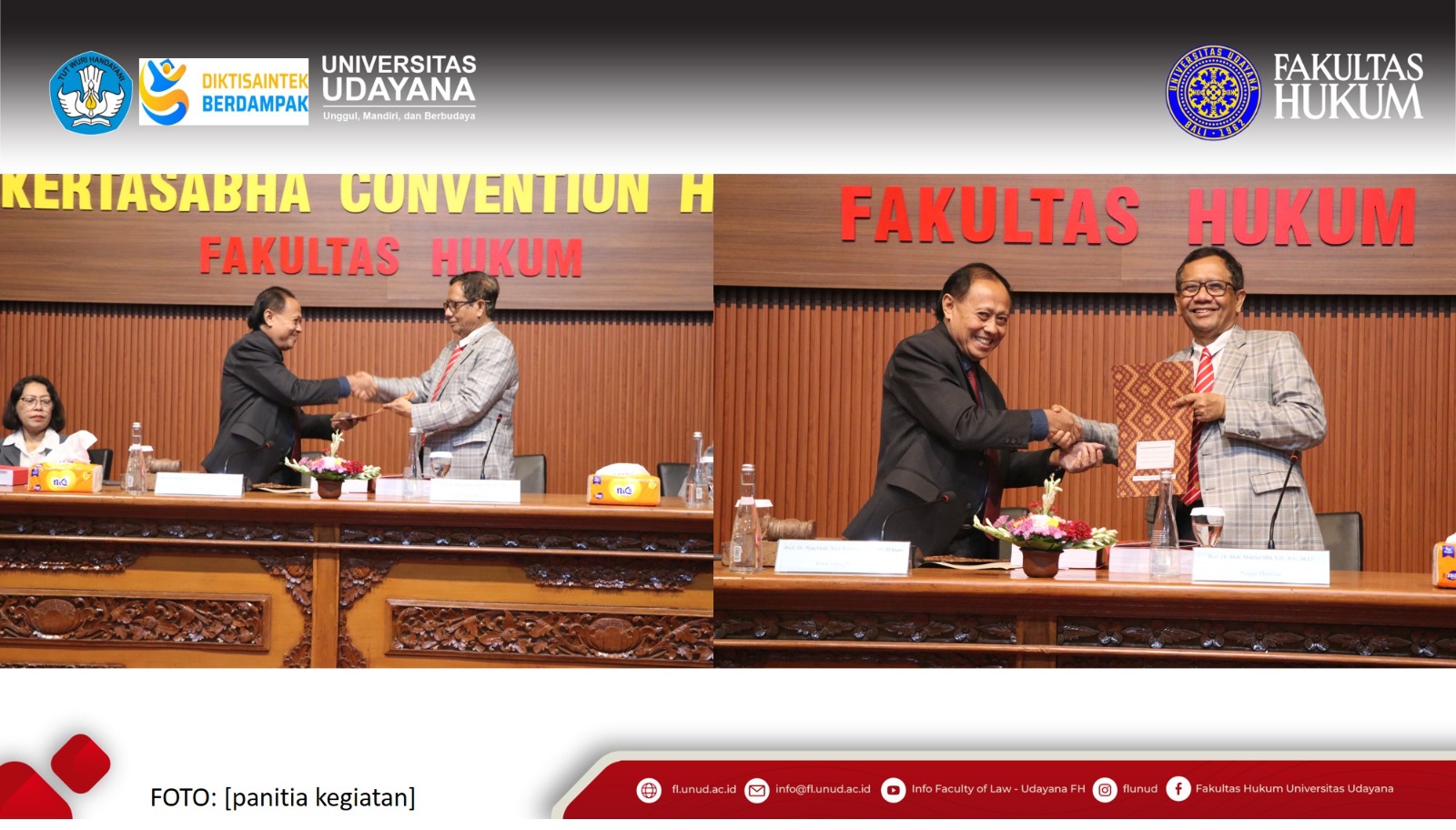
This academic session was chaired directly by the Dean of the Faculty of Law, Udayana University, who also served as Promoter, Prof. Dr. Putu Gede Arya Sumerta Yasa, S.H., M.Hum., accompanied by Dr. Sagung Putri M.E. Purwani, S.H., M.H., as Co-Promoter I and Dr. Diah Ratna Sari Hariyanto, S.H., M.H., as Co-Promoter II. The presence of prominent constitutional law expert Prof. Dr. Moh. Mahfud MD., S.H., S.U., M.I.P., Ph.D., as External Examiner lent profound academic weight to the discussion. Also serving on the Board of Examiners were professors and senior academics of FH UNUD, namely Prof. Dr. I Wayan Parsa, S.H., M.Hum., Prof. Dr. Gde Made Swardhana, S.H., M.H., Dr. Ida Bagus Surya Dharma Jaya, S.H., M.H., and Nyoman Satyayudha Dananjaya, S.H., M.Kn., Ph.D.
In his dissertation presentation, Dr. I Made Suardana highlighted a crucial issue at the intersection of corruption eradication and the protection of citizens' constitutional rights to legal assistance. To date, the absence of clear procedures in Article 21 of the Anti-Corruption Law (UU PTPK) has frequently created a gray area between legitimate legal defense and obstruction of justice. This procedural normative vacuum in assessing an advocate's good faith risks triggering selective enforcement, legal uncertainty, and a chilling effect that threatens the independence of the legal profession when representing clients.
As a legal reform proposal (ius constituendum) and conceptual novelty, this research introduces the Ethical Audit Pre-Justicia mechanism through the establishment of a sui generis bridging institution named the Joint Committee. This concept is proposed for integration into the amendment of the Anti-Corruption Law through the addition of Article 21A. Under this provision, any alleged act of obstruction of justice committed by an advocate in performing their professional duties must undergo a pre-judicial ethical audit process before law enforcement officers can name them a suspect, without impeding the ongoing investigation of other primary suspects.
The Joint Committee is designed to consist of five members with a balanced 2-2-1 composition to prevent dominance and partiality. Its membership comprises two representatives from law enforcement agencies (one each from the Indonesian National Police or the Corruption Eradication Commission [KPK], and the Attorney General's Office), two representatives from the Honorary Council of the Bar Association where the advocate is registered, and one judge or legal academic acting as a neutral chairperson holding a casting vote in the event of a deadlock. The committee's decision is binding: if a certificate of good faith is issued, investigators are obligated to terminate the investigation, whereas a certificate of lack of good faith serves as the basis for proceeding with the criminal process.
Beyond offering a long-term institutional design through statutory revision, the dissertation also recommends short-term strategic measures in the form of issuing a Supreme Court Circular or Regulation (SEMA/PERMA) and formulating joint coordination guidelines among the Supreme Court, the Indonesian National Police, the Attorney General's Office, the KPK, and Bar Associations. This academic concept is expected to foster a fair balance between state authority in safeguarding the integrity of the justice system and guaranteed protection for the legal profession as an integral pillar of the rule of law.
Gallery
UDAYANA UNIVERSITY