 ENG
ENG
 INA
INA
Unud Law School Doctoral Defense: Erwin Siregar Proposes the Formation of a National Supervisory and Honorary Council for Attorneys
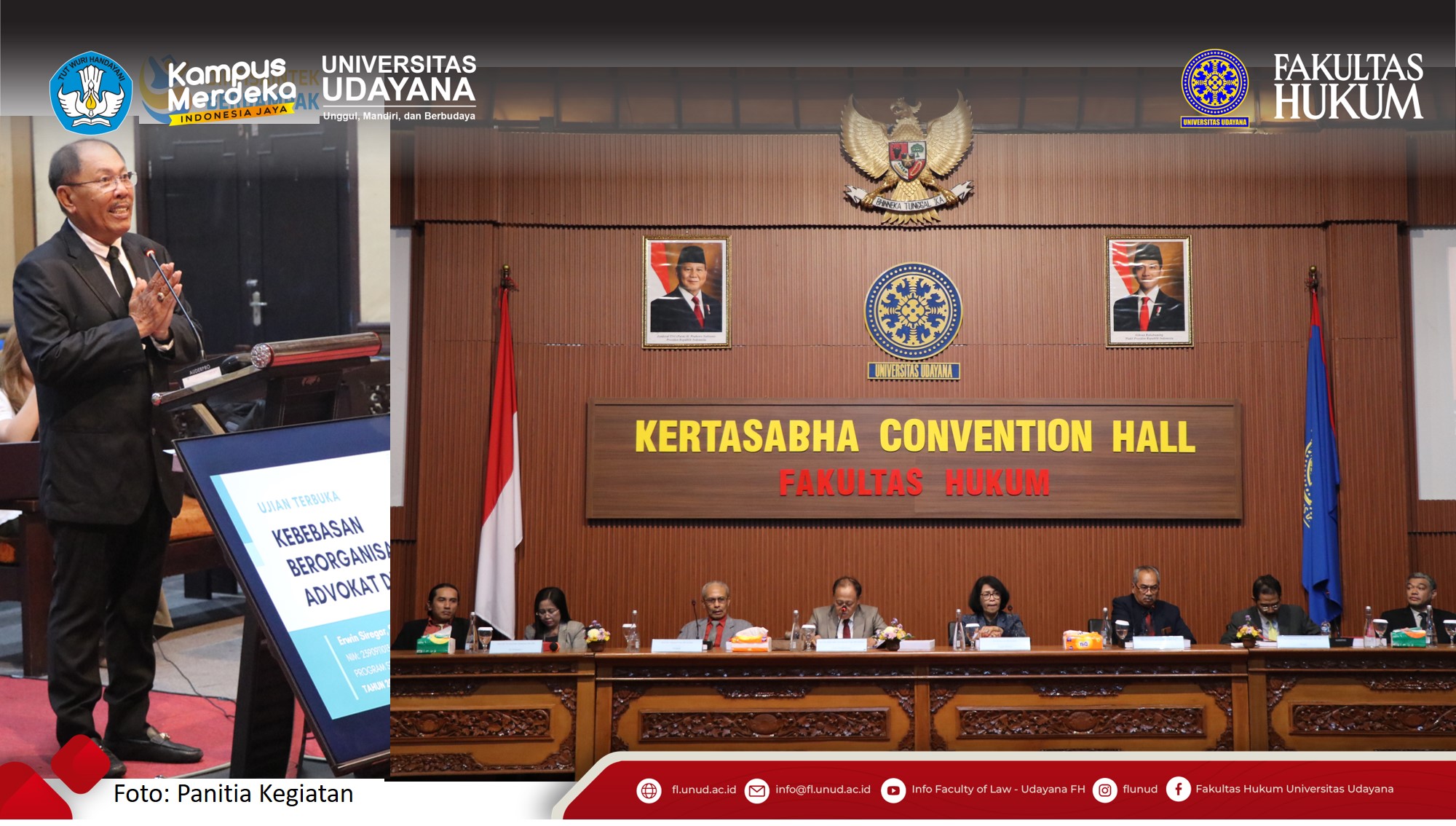
Denpasar – The Doctoral Study Program in Law at the Faculty of Law, Udayana University, held the Stage II Final Examination—or the Open Doctoral Promotion Examination—for doctoral candidate Erwin Siregar. This academic event, which took place on Tuesday, September 22, 2026, at the Kertasabha Convention Hall of the Faculty of Law, Udayana University (Denpasar), focused on a dissertation titled "Freedom of Organization for Advocates in Indonesia." The open examination was chaired by Prof. Dr. Putu Gede Arya Sumerta Yasa, with Prof. Dr. I Wayan Parsa serving as the Promoter, and Prof. Dr. Ni Luh Gede Astariyani and Dr. I Wayan Novy Purwanto acting as Co-Promoters. The examination panel also included Dr. Ifa Sudewi as the external examiner, alongside Prof. Dr. Gde Made Swardhana, Dr. I Gede Pasek Eka Wisanjaya, and Dr. Jimmy Z. Usfunan as members of the examining team. In his presentation, Erwin Siregar explained that, philosophically, the freedom of advocates to organize constitutes a right to freedom of association guaranteed under Articles 28 and 28E paragraph (3) of the 1945 Constitution of the Republic of Indonesia (UUD NRI 1945). However, this right is not absolute and may be proportionally restricted pursuant to Article 28J of the 1945 Constitution to respect the rights of others within a democratic society. From a legal perspective, the emergence of "multi-bar" practices following the issuance of the Supreme Court Chief Justice’s Letter Number 73/KMA/HK.01/IX/2015 and Constitutional Court Decision Number 126/PUU-XXIV/2026 has not yet resolved normative requirements regarding membership limits and the regulation of advocate organizations. Sociologically, this regulatory void has triggered a phenomenon wherein advocates switch organizations following dismissal or resignation—a trend that potentially prejudices the interests of justice seekers and tarnishes the image of the legal profession. This normative legal study—employing statutory, contextual, historical, and comparative approaches—examines Vietnam as a case study for comparison. Vietnam was selected due to shared civil law system characteristics, mutual ASEAN membership, and the implementation of a multi-bar system. Vietnamese regulations are considered particularly relevant as they enforce a "one lawyer, one bar" principle, establish formal transfer mechanisms, and strictly prohibit dismissed advocates from joining other organizations. To address the issues at hand, the doctoral candidate proposes a framework for *ius constituendum* (future law) through amendments to the Law on Advocates and the Indonesian Code of Ethics for Advocates. Key recommendations include mandating that advocates hold membership in only one organization, prohibiting the admission of advocates previously dismissed by another organization (and revoking their official oath records), and establishing a National Council for Advocate Supervision and Ethics. This proposed independent body—comprising 15 members drawn from the ranks of advocates, academics, retired judges, public figures, retired law enforcement officials, and professional ethics experts—is envisioned as the sole authority for enforcing the code of ethics and overseeing advocates in Indonesia.
UDAYANA UNIVERSITY